.png?width=159&height=32&name=careerarc-logo-h-black%20(3).png "careerarc-logo-h-black (3)")

Data-driven recruiting: 5 metrics you should care about
By Alexa Nizam on Jun 5, 2025, 8:42:59 AM
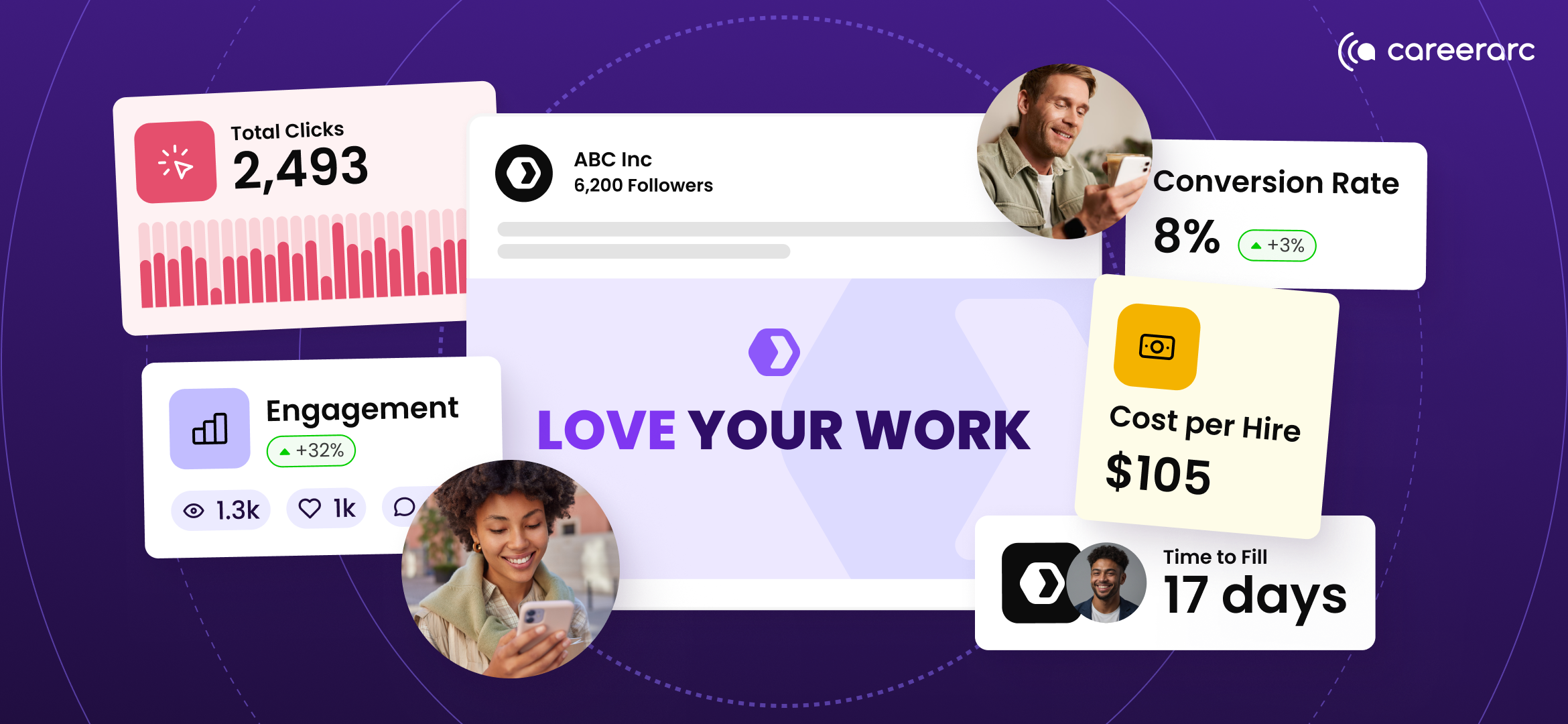
You already know that social recruiting can supercharge your talent pipeline, but without the right data, it’s easy to feel like you’re flying blind.
Today’s recruiting platforms offer dozens of metrics, dashboards, and reports… which makes it even easier to lose sight of what really moves the needle. More data doesn’t always mean better results! The key to a successful, scalable recruiting strategy is knowing which numbers actually matter—and how to act on them.
Below, we’ll walk through five essential recruiting metrics every talent team should track. Whether you’re fine-tuning your social recruiting data or building a foundation from scratch, these insights will help you make smarter decisions and attract better talent.
1. Engagement rate
Let’s start at the top of the funnel: engagement.
Engagement rate measures how many people react to, comment on, share, or click your post out of everyone who saw it. In other words, it’s a pulse check on how compelling your content really is.
If your engagement is low, it’s unlikely your audience is paying enough attention to click “Apply,” let alone submit an application. Think of engagement as the spark that starts the candidate journey.
To improve this metric, think about the kind of content that makes you stop scrolling. Team shoutouts, behind-the-scenes clips, and quick “day in the life” videos all help candidates imagine what it’s like to work at your company. Branded graphics, quote cards, and simple templates can also help you stay consistent and on-brand, especially when you’re posting at scale.
Need even more engagement? You can also experiment with lighthearted prompts that encourage participation. Questions like “What’s your go-to Monday morning song?” or “Drop the GIF that sums up your week” give candidates a reason to interact—and keep your employer brand top of mind.
2. Click-through rate (CTR)
Once you’ve captured attention, the next step is encouraging action.
Click-through rate (CTR) tracks how many people clicked a call-to-action link (like “See Open Roles” or “Apply Now”) compared to how many saw the post. A strong CTR means your messaging is resonating enough to move someone from social media into your hiring funnel.
If your CTR is low, it could be a sign that your post lacks a clear or compelling CTA, or that your visuals and headlines aren’t strong enough to earn that next step.
To boost CTR, place CTAs directly after something that grabs attention, like a powerful stat or short employee quote. Be specific with your language, too. “Apply now to join our sales team” is more effective than a vague “Learn more.”
Also, keep an eye on platform performance. If LinkedIn posts drive significantly more clicks than Facebook, consider reallocating your budget to prioritize what’s working or testing new messaging on the underperforming channel.
3. Application conversion rate
Clicks are great, but they don’t mean much if candidates abandon the process once they land on your careers page.
Application conversion rate measures the percentage of visitors who actually complete an application after clicking through. According to HireHive, a typical application conversion rate ranges between 7% and 10%, and anything above that is considered strong.
If your numbers fall short of that benchmark, your application process may be introducing too much friction. Are you asking candidates to fill out multiple pages? Are the job descriptions too vague or too long? Are mobile users getting stuck?
Put yourself through the application flow and see where you get confused or frustrated, and remember that small improvements can go a long way! For example, reducing the number of required fields, adding a “copy from resume” feature, or making the application mobile-friendly can all help lift conversion rates and prevent drop-off.
4. Time to fill
Next, time to fill tracks how many days pass between your first post about an open role and the moment a candidate signs their offer letter.
Optimizing this metric matters for two big reasons: it keeps your best candidates engaged and reduces your overall cost of hiring. A shorter time to fill also prevents top talent from getting snapped up by competitors while your process drags on.
To improve this metric, look for opportunities to streamline your hiring flow. Automating steps like interview scheduling with calendar links or chatbots can shave off days (or even weeks!).
If certain roles consistently take longer to fill, dig into your pipeline. Are there bottlenecks in sourcing, screening, or interviews? Identifying where candidates drop off—or where your team slows down—can reveal actionable ways to speed things up.
5. Cost per hire
Finally, cost per hire shows how efficient your recruiting strategy really is. This metric calculates the total cost of your social recruiting efforts (ad spend, platform fees, agency costs, etc.) divided by the number of hires made through those channels.
Knowing this number helps you make smarter budget decisions, so you can double down on high-ROI campaigns and cut underperforming ones.
For example, if you find that video ads consistently lead to a lower cost per hire than static image ads, shift more budget toward video. You can also experiment with tactics like day-parting (running ads during peak user hours) to stretch your budget even further.
Using CareerArc for data-driven recruiting
Juggling all these metrics can feel like a full-time job, but CareerArc makes it a whole lot easier. Our recruiting analytics suite brings your key social data—like engagement rate, CTR, and post performance—into one clear, easy-to-navigate dashboard.
You can compare how each platform is performing, set alerts when engagement dips, and schedule content across LinkedIn, Facebook, Instagram, and X—all from the same place. And while we don’t yet track full-funnel metrics like application conversion or cost per hire, our tools give you a strong read on what’s resonating on social and where to focus next.
Ready to see it in action? Book a demo or try it for yourself to start building a more efficient, data-driven recruiting strategy.
- Social Media Strategy (138)
- Best Practices (105)
- Employer Branding (105)
- Talent Acquisition Strategy (50)
- Candidate Sourcing (48)
- Webinar Recap (35)
- Research & Data (33)
- Facebook (25)
- Featured (24)
- Case Study (23)
- Awards & Recognition (22)
- Platform News (21)
- Employee Advocacy (19)
- How-To Guide (18)
- Job Advertising (18)
- Retention & Engagement (18)
- Diversity & Inclusion (17)
- Industry News (17)
- Analytics & ROI (15)
- Healthcare (13)
- Twitter (13)
- Candidate Experience (12)
- COVID-19 (9)
- Remote Work (9)
- LinkedIn (8)
- Multi-Platform Social (7)
- HR Management (6)
- Seasonal Hiring (6)
- Events & Conferences (5)
- Instagram (5)
- Retail (5)
- AI & Automation (4)
- Career Development (4)
- HR Software (4)
- Guest Content (3)
- Reddit (3)
- Hourly & Frontline Workers (2)
- Multi-Location Hiring (2)
- Product Announcement (2)
- Recruitment Platforms (2)
- Hospitality (1)
- June 2026 (1)
- May 2026 (1)
- April 2026 (5)
- December 2025 (1)
- October 2025 (1)
- September 2025 (1)
- August 2025 (1)
- July 2025 (1)
- June 2025 (1)
- March 2025 (1)
- February 2025 (1)
- January 2025 (1)
- December 2024 (1)
- November 2024 (1)
- October 2024 (1)
- August 2024 (1)
- July 2024 (1)
- June 2024 (1)
- May 2024 (1)
- April 2024 (1)
- March 2024 (1)
- February 2024 (1)
- January 2024 (1)
- December 2023 (2)
- November 2023 (1)
- October 2023 (1)
- September 2023 (1)
- August 2023 (1)
- January 2023 (1)
- December 2022 (2)
- November 2022 (3)
- October 2022 (3)
- September 2022 (6)
- August 2022 (5)
- July 2022 (4)
- June 2022 (5)
- May 2022 (5)
- April 2022 (5)
- March 2022 (6)
- February 2022 (6)
- January 2022 (3)
- December 2021 (4)
- November 2021 (6)
- October 2021 (7)
- September 2021 (6)
- August 2021 (9)
- July 2021 (5)
- June 2021 (4)
- May 2021 (4)
- April 2021 (3)
- March 2021 (4)
- February 2021 (4)
- January 2021 (2)
- December 2020 (4)
- October 2020 (1)
- September 2020 (1)
- August 2020 (1)
- July 2020 (5)
- June 2020 (6)
- May 2020 (6)
- April 2020 (9)
- March 2020 (10)
- February 2020 (9)
- January 2020 (15)
- December 2019 (6)
- November 2019 (12)
- October 2019 (9)
- September 2019 (14)
- August 2019 (10)
- July 2019 (11)
- June 2019 (10)
- May 2019 (11)
- March 2019 (1)
- January 2019 (2)
- December 2018 (1)
- November 2018 (1)
- October 2018 (1)
- September 2018 (3)
- August 2018 (2)
- July 2018 (3)
- June 2018 (2)
- April 2018 (1)
- March 2018 (3)
- February 2018 (2)
- January 2018 (4)
- December 2017 (2)
- November 2017 (3)
- October 2017 (2)
- September 2017 (3)
- August 2017 (3)
- July 2017 (1)
- June 2017 (3)
- April 2017 (2)
- February 2017 (2)
- January 2017 (2)
- December 2016 (2)
- October 2016 (1)
- September 2016 (3)
- July 2016 (1)
- June 2016 (2)
- May 2016 (1)
- March 2016 (1)
- February 2016 (2)
- January 2016 (2)
- December 2015 (4)
- November 2015 (5)
- October 2015 (3)
- September 2015 (3)
- August 2015 (3)
- July 2015 (4)
- June 2015 (2)
- May 2015 (2)
- April 2015 (10)
- March 2015 (2)
- February 2015 (3)
- January 2015 (3)
- December 2014 (2)
- November 2014 (2)
- October 2014 (3)
- September 2014 (2)
- August 2014 (3)
- July 2014 (4)
- June 2014 (4)
- May 2014 (3)
- April 2014 (1)
- November 2013 (1)
- July 2013 (1)
- April 2013 (2)
- February 2013 (1)
- January 2013 (1)
- December 2012 (1)
- October 2012 (2)
- September 2012 (2)
- August 2012 (2)
- July 2012 (2)
- June 2012 (1)
- May 2012 (4)
- April 2012 (2)
- March 2012 (6)
- February 2012 (4)
- January 2012 (3)
- November 2011 (1)
You May Also Like
These Related Stories

20 Mind-Blowing Social Recruiting Statistics [2019]
Social recruiting vs. traditional recruiting: what’s the difference?